Issue #: SP26
Published: September / October 2026
- Price per issue - digital : 6.50€Digital magazine
- Price per issue - print : 10.50€Print magazine
- Price with subscription : from 2.91€Subscribe
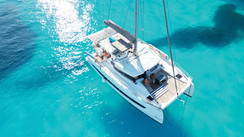
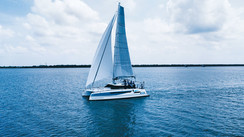
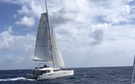
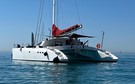
At a time when most multihull shipyards are offering hybrid options, charter companies appear to have side-stepped the idea somewhat… But does that mean all of them? Actually, no, because Dream Yacht has been offering Fountaine Pajot catamarans equipped with electric motors for the past three years. But is this concept appealing and suitable for the average boater? That’s what we set out to find out when we embarked on a week-long trip aboard an Aura 51 Smart Electric - a former model name that has since become FP51 ODSea+.
Greater self-sufficiency, cleaner and quieter sailing, easier maneuvering, and the ability to generate “clean” energy via solar panels and hydrogeneration: these are the promises of hybrid propulsion. Admittedly, though, there are various issues still to be addressed, such as still-limited speed in all-electric mode, excessive energy consumption when motoring into the wind or against the waves, low efficiency of the solar panels on overcast days, the need to closely monitor the battery level, and, of course, the overall reliability of the system. These issues may explain a certain degree of market hesitation (the sales ratio of hybrid to conventional models remains at 5% to 95%).
When we undertake boat tests for our reports, we’re always accompanied by technicians and managers from the shipyard, and the sailing sessions last three to four hours, sometimes most of the day, and we’re sailing on a boat that’s fresh off the production line. So, in order to discover the real, autonomous sailing experience aboard a multihull that’s already proven itself at sea, the idea of a week-long test came to us.
Dream Yacht was the first charter company to acquire a fleet of hybrid catamarans, and they proposed we check out an FP51 out of their base in Naples, Italy. All that was left to do was to put together a crew… which turned out to be a no-brainer. My former shipmates from my days in the French Navy and I were planning to celebrate the 40th anniversary of a circumnavigation we made aboard Ouragan, a landing craft transport ship. I know these guys well, of course, and they don’t do things by halves… And being epicureans at heart, they would be the perfect combination to make full use of a boat’s energy resources!
Our itinerary included exploring the iconic islands of Procida and Capri, then the Amalfi Coast with Positano, and finally heading back to Sorrento, Naples, and Ischia to wrap things up. It was a classic coastal cruising itinerary: just over 100 nautical miles through a dreamy Mediterranean seascape.
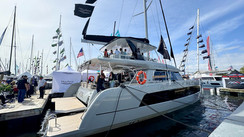
As we explored our vessel, we were pleasantly surprised to find that three charter seasons hadn’t diminished its status as an ultra-comfortable catamaran. Of course, we couldn’t help but compare it to a brand-new sister ship moored alongside…
Guiseppe Falanga, the base manager, conducted the technical briefing for us and the other crews who would be sailing aboard the other FP51 Electric catamarans. This briefing took a little longer than it typically would have done for a conventional diesel- powered catamaran.
While it might have appeared a bit confusing at first, we had to admit that it was ultimately very simple. Between our first-generation Smart Electric and the recent ODSea+ models, there are a few minor differences in the layout of the control panels and some of the ...
What readers think
Post a comment
No comments to show.