Downwind Sails

Make Sure You Have the Right Code!

The spinnaker, asymmetrical or otherwise, is known to every sailor (even if this nylon sail too often remains sat in its bag). The gennaker, a contraction of spinnaker and genoa, has established itself thanks to its ease of use with a furler. With the reacher, a genoa with shortened leech and extended foot, we’re not far from losing you... And if we tell you about codes, are you still with us?

The world of downwind sails can sometimes seem obscure, as each sail is adapted to a specific use, while at the same time meeting classification criteria for the various classes (old or new). Things get even more complicated when sailmakers introduce their own names, adding to the confusion. This is particularly true with the “codes”, which now come in many different versions. To help you in your exploration or choice, here is a bit of decoding on the world of codes with numbers and letters... and their uses: to begin with, let’s write Code with a capital letter.

If most sailmakers tell you that a gennaker is hollower (and therefore more suitable for downwind sailing) than a Code, that’s fine with everyone, but... a Code is a gennaker, except that it’s considered more “naker” than “gen” for the classes, i.e. it’s officially classified as a spinnaker.

A little history: the Code 0, still the best-known of its family, appeared on the Whitbread (crewed round-the-world race with stopovers) in the late 90s to get around the regulations and add a sail more powerful than a genoa without incurring a rating penalty. This sail quickly made its way into ocean racing in the early 2000s and, beyond the fact of getting around the regulations, has proved to be as effective as it is easy to maneuver on cruising yachts - especially our multihulls.

What is a Code?


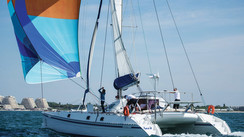
A Code is a headsail that isn’t hanked-on or slotted in the groove of a luff foil, and it represents an intermediate sail, in terms of shape, between a genoa and an asymmetrical spinnaker. It is ideally attached on a bowsprit, with the halyard sheave as high up the mast as possible. The Code is usually deployed from a furler, making it easy to hoist and unfurl. The optimum range of use is from 70 to 110° off the true wind (preferably in light to moderate airs). A Code can be used at higher points of sail, but its performance is much lower than that of an asymmetrical spinnaker, which is hollow and, above all, much larger. With a Code, it’s easier to gybe than to tack, because in the latter case you’ll need to furl the sail a little before tacking

The Code 0 and the Others…


While the generic name for this sail remains Code 0, manufacturers have developed different geometries to adapt it to different types of sailboats, particularly multihulls. As a result, we end up with a number of names that are mainly trade names, even if they represent slightly different sails. What’s more, virtually every manufacturer has its own nomenclature.

Originally, a Code 0 spinnaker had a minimum aspect ratio of 75%. But in the world of cruising, this imperative can disappear, and it’s precisely this new ratio that is appearing at North Sails with less hollow sails (Code 65 or Code 55). Other manufacturers such as Quantum Sails or Incidence, to name but a few, use simple numbering (0, 1, 2, 3, 4, 5...) Generally speaking, the smaller the number, the flatter the sail for a narrower wind angle.

A Code for Your Multihull


In any case, before signing an order form for a Code, whatever the version, you should contact your sailmaker. Together with a specialist, you’ll take into account the characteristics of your multihull - starting with its length, its displacement and the position of the mast on deck.

After the specifications of your catamaran or trimaran, your type of sailing will be essential. Whether you’re simply a family cruiser, or you like to take part in a bit of racing, your sail will be different.

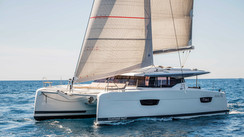
For most cruising multihulls, the ideal sail is an intermediate Code - neither too flat nor too hollow - installed on a furler. A sail that will be versatile, light and therefore easy to handle.

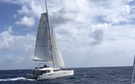
Code sails are ideally designed for a angle of 70° to 110° off the wind... but there’s nothing to stop them being used downwind, goose-winged with the mainsail.
A Code is usually rigged from a bowsprit and installed on a furler.
North Sails offers their Code Helix range in 4 different models.

Most-read articles in the same category

View all the articles

Current issue

MW207 - May-June 2026

Discover the issue

Subscribe now

The latest news from €3 / month

Subscribe to the magazine

Video of the month

Our latest YouTube hit!

Watch the video

The Multihull of the Year

Votes are open!

Vote for your favorite multihulls
For all used-boats for sale

Classified ads

View classified ads
ORC 42
Location :
Bastia-Corsica, France
Year :
2023
515 000,00 Inc. tax€
Transcat 42
Location :
Bastia-Corsica, France
Year :
2003
220 000,00 €
PIANA 30'
Location :
BASTIA, France
Year :
1992
50 000,00 Inc. tax€