Issue #: 207
Published: May / June 2026
- Price per issue - digital : 6.50€Digital magazine
- Price per issue - print : 9.50€Print magazine
- Access to Multihulls World digital archives Digital archives
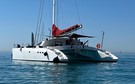
The Multihulls World community is well acquainted with the crew of the Saona 47 Ile de Rey, as we’ve been following Catherine and Stéphane for the past four years. The French couple has now logged well over 20,000 nautical miles aboard their catamaran, and we’ve featured their latest adventures along the US East Coast in our Postcards column. Here’s the full story of their stopover of a lifetime: New York!
With our B2 visas obtained, we were heading up the East Coast of the USA after three months of wonder in the paradise islands of the Bahamas.
Saint Augustine, Savannah, Charleston, Beaufort - names that evoke Victorian or colonial architecture. Everything is green, peaceful, and calm: Scarlett and Gone with the Wind seem close at hand, bathed in the sun and warmth of the spring. Anchorages are easy, and there are few long-term cruisers. We could almost settle down here, savoring the languid tranquility of the Southern states.
The locals are wide-eyed at the audacity of these French people who have come from so far away - they are kind and welcoming. The states pass by in succession: Florida, Georgia, South Carolina, then North Carolina. Before our bows, the dreaded Cape Hatteras is finally rounded without incident - a stroke of luck.
Ile de Rey reaches Norfolk, Virginia, and effortlessly crosses paths with aircraft carriers and other warships. The US Navy ships respectfully call out to us on channel 16: “Do you want to pass starboard to starboard or port to port?” - we are truly impressed…
Then Delaware and New Jersey watch us sail by, and we’re still the only boaters on the water. The landscapes have changed, concrete jungles have sprouted along the coast, and modernity seems to have taken over. Our stops are now purely technical before we finally reach the Big Apple, the highlight of our summer journey through America.
The temperature swings from 90°F to 62°F (32 to 17°C), with sunshine and gray skies playing hide-and-seek. What remains constant, however, is the extreme humidity: laundry takes over 20 hours to dry.
And on a beautiful June morning, we set off from Sandy Hook, a long peninsula located at the northern tip of New Jersey. After a few hours of sailing almost due north, we glimpse the Verrazzano-
Narrows Bridge through the mist, which we unfortunately have to motor through - under sail would have been truly magnificent. The green and red buoys marking the channel clink under the rolling waves, reminding us that New York can disappear into the fog (40 days a year on average). As usual, navigating the buoyage requires a bit of mental gymnastics since, in the USA, as in the Caribbean,
the red and green colors are reversed compared to Europe. Before the bridge, the famous attractions of Coney Island rise up to starboard, then we finally pass under the
Verrazzano-Narrows Bridge, the unmistakable and colossal gateway to New York – a few figures to convince you: the structure is 13,704 ft (176 m) long, 693 ft (211 m) high, and provides clearance for ships with a clearance of up to 228 feet (70 m). Here we are, entering Upper New York Bay. To port, Staten Island is mostly green, and houses are somewhat hidden away, while opposite, Brooklyn displays its skyscrapers, and we can already make out the eponymous bridge. In the distance, to the left, the commercial port reveals gigantic unloading docks, mountains of containers beneath enormous overhead cranes, and of course, dozens of cargo ships, some waiting their turn, anchored in the middle of the bay. The tip of Manhattan finally emerges directly ahead, crowned by One World Trade Center. It’s impossible to miss this 104-story tower, some 1,776 feet (541 m) high with its spire: built on the site of the Twin Towers destroyed by the attacks of 9/11, 2001, it is now the tallest building in the United States.
The Empire State Building and the Chrysler Building can be admired in the background. Finally, we glimpse the long-awaited grand dame, the French statue of 1886, the eldest of Auguste Bartholdi’s works, the big sister of the one on the Grenelle Bridge in Paris: The Statue of Liberty! Upon our arrival around noon, we anchor almost at the foot of its pedestal, as a sign of respect and allegiance.
We thought we’d have to weave our way through hundreds of boats to anchor in this legendary spot, but not at all! There were only four of us scattered in the anchoring - the recreational craft that frequent this area can be counted on one hand. In contrast, tourist shuttles run every 10 minutes to Liberty Island, the orange ships ferrying passengers between Staten Island and Manhattan follow one another in a long line, jet skis leap and buzz in the green water, helicopters hurry by and disappear just as quickly… In short, it’s bustling, it’s alive: we’re definitely in New York, far from the gentle torpor of the South.
After promising ourselves New York for so long, we’re quite proud to have achieved our goal. We then recall a conversation at a boat show with Claire Fountaine, President of Fountaine Pajot: she described her arrival in New York and her anchorage at the foot of the Statue of Liberty: we were filled with admiration and envy… Well, here we are, it’s our turn, thank you for inspiring us! There was an American in Paris, Emily in Paris… now we’ll also have to reckon with Ile de Rey in New York!
Five years after buying our Saona 47, what better way to celebrate our 22,000 nm (40,000 km) journey - the equivalent of a trip around the world - than by arriving in New York?
4:43 PM: Stéphane, my husband, sees the storm coming, and we bring in everything we can - cushions, shoes, etc. 4:44 PM: We are in complete darkness.
In the space of 20 seconds, the wind climbs to 60 knots. The shrouds whistle, the bay is white with fury, and small, flattened waves lash against our hulls. A chair goes flying -
Stéphane catches it just in time. Suddenly, we notice the red buoy… which shouldn’t be there since we were next to the green one! Horror! We’ve already dragged 500 ft (150 m)! Stéphane engaged the engines to reduce the strain on the anchor and stabilize us until the wind died down… The episode ultimately lasted only 5 minutes; the rain stopped suddenly, the sun reappeared, and a magnificent rainbow formed over Manhattan. We re-anchored further out with 100 feet (30 m) of chain and a 40-foot (12 m) bridle in 8 feet (2.5 m) of water. More of a scare than anything else. That’s what cruising is all about… In the evening, we watched in awe as the Manhattan skyscrapers were illuminated in a magical display; our foreground became golden lace on steel and mirrored glass, like a mashrabiya backlit with a diffuse, shimmering light. The Statue of Liberty also lit up its crown and pedestal with a golden glow. We were spoiled and realized how privileged we were to enjoy this spectacle so close up. No one joins us, no one approaches us: we remain alone at anchor, seemingly to the complete indifference of the Coast Guard. Moreover, against all expectations, the night is very calm. No coming and going of boats, no blaring music, no helicopters: the water remains a silent, almost solemn mirror.
In the morning, it’s “only” 72°F (22°C); the forecast predicts 78°F (27°C) later in the day with sunshine and moderate humidity. However, a choppy sea due to a 15-20 knot wind is churning up the water.
We weigh anchor for Port Washington, located northeast of New York City, at the very beginning of Long Island’s north shore.
Beforehand, we took a trip on the Hudson River, west of Manhattan. We discovered the city and its skyscrapers from a different perspective, and since one building can hide another, each view is a new discovery. The Hudson is wide, there’s little traffic, but it’s impossible to anchor there - and in any case, the tidal current is very strong. So we took the East River to head towards our destination for the day.
As we anticipated, the rising tide was in our favor - the average current was 2.7 knots and even climbed to 5.9 knots at half tide. As a result, our GPS showed an improbable top speed of 11 knots! We were accompanied by a deafening and constant din: the characteristic clatter of helicopter blades – they take off by the dozen from the floating docks – the wail of ambulance and police sirens, the drone of seaplanes taking off ahead of us, the more muted purr of countless ferries…
Near the bridges, cars, motorcycles, and subways take up the rhythm in turn. In short, on board, you can’t hear yourself think! The East River is a veritable beehive compared to the Hudson River. In any case, one thing is certain: New York is awake. We pass by buildings of all sizes and diverse architectural styles – austere red brick mingles with turn-of-the-century structures with their Disneyland-like peaks and steel and mirrored towers. At the foot of the towers, a few low structures remain, looking ridiculous: the spectacle is fascinating!
The bridges follow one after another: Brooklyn, Manhattan,
Williamsburg, Ed Koch Queensboro… All these structures are beautiful and majestic. The oldest is Brooklyn, completed in 1883, but all are true feats of engineering. Brooklyn stands out for its minimum clearance at half tide – 127 feet (38.7 m). The other spans are over 130 feet ( 40 m), but there’s still a comfortable 50 feet (15 m) above the VHF antenna on Ile de Rey… We pass right by Rikers Island: the prison is clearly visible, as are the barbed wire fences… we can even make out the white buses used for prisoner transfers.
We’re soon under the flight path of airplanes landing at LaGuardia - the landing gear seems to be practically touching our mast!
Carried by the power of the tide, we effortlessly (and in record time) cover the 20 miles to a vast bay on the north coast of Long Island, lined on either side with deep, wide coves. The stop we’re heading to is called Port Washington. We discovered the houses on the waterfront. What am I saying, houses? They’re not even villas anymore, they’re veritable 4XL mansions nestled in lush greenery, each with its own private dock, of course.
And here we are at last at the mooring we reserved. For $35 a night, the water taxi to shore is free, as many times as we like. No need to launch our dinghy.
Manhasset Bay is a perfect all-weather anchorage. We’re only a 45-minute train ride from Manhattan, which is why we chose Port Washington. This location allows us to easily visit New York for two or three days without leaving the dinghy on the shore. To top it all off, the anchorage is charming and breezy.
Even though we’ve already been to New York, going back was an incredible opportunity for us. And off we went, headbands on for the heat and hats on our heads. The train took us directly from Port Washington to Penn Station, right in the heart of Manhattan - just a stone’s throw from Times Square and our hotel. In 100 to 104°F (38 to 40°C) heat, we crisscrossed Manhattan - over 18 miles (30 km) on foot in 3 days, a real marathon for us! We avoided places we already knew to discover New York’s newer neighborhoods. We arrived in Little Island; its enormous flowerbeds, shaped like artichoke hearts and several feet high, were built on the remains of the Pier 51 pillars destroyed during Hurricane Sandy in 2012. Next up was the High Line, a landscaped walkway built on a former railway line that crossed Manhattan along the Hudson River. From there, we overlooked the newly renovated neighborhoods of the Meatpacking District and Chelsea, all the way to Hudson Yards. We ascend in 52 seconds to the 100th floor of The Edge and its outdoor observation deck, 1,100 feet (335 meters) above the city – the highest skydeck in the Western Hemisphere, offering a guaranteed 360° view. On the descent, we couldn’t help but admire The Vessel, a 150-ft (46 m) high structure that was inaugurated in 2019. While its architecture and copper color evoke a honeycomb, the monument conceals some 2,500 steps on 80 landings and 154 flights of stairs. Gazing upwards, we scanned the neon lights of Times Square. To give ourselves a break, we took an open-top bus for a complete tour of Manhattan. We visited two modern art museums; for me, the MoMA and the Whitney Museum of American Art are absolutely essential. Then, without missing a beat, we discovered the deeply moving 9/11 Museum – not for the faint of heart.
A little later, the two floors of the incredible M&M’s store felt much lighter psychologically: welcome to the temple of the candy that melts in your mouth, not in your hand! We also cycled the entire length of Central Park (not even on an electric bike!), a whopping 7 miles (11 km) of cycle path under a blazing sun. Believe it or not, the route is anything but flat!
Throughout our stay in the heart of New York, we always felt safe in this hyperactive city, which we found clean and welcoming. Public transportation is very reasonably priced: $2.90 for the subway, $9.50 for our 45-minute train ride.
After these three incredible days, we returned to our anchorage, again by train, completely exhausted. On board, we jumped into a cold shower, but we were happy to have lived the New York dream.
This picture wouldn’t be complete without mentioning a pit stop to taste the one and only, the real deal, the New York Cheesecake.
The very next day, we set off again for new anchorages along the very chic north coast of Long Island, but first, we can’t avoid the sacrosanct ritual of provisioning for the coming days, a task thankfully made very easy by the presence of a shopping mall with its two reasonably priced supermarkets, restaurants, and even a chandlery - all within walking distance.

What readers think
Post a comment
No comments to show.