Rental and charter of catamaran and sailing guide The Venezuelan Islands
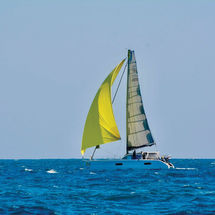
The Venezuelan IslandsUntil recently reserved for long-term cruisers, the Venezuelan islands are exceptional, both for their beauty and their isolation. A spectacle that you can now discover aboard a Privilège 495, and soon a 615.
PRACTICAL VENEZUELA
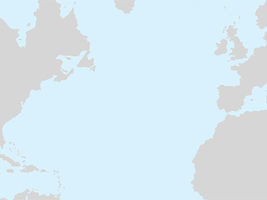
Situation: The Venezuelan territory stretches from around the equator to north of the eleventh parallel. It also has 72 islands, scattered in the Caribbean Sea and the Atlantic Ocean. Of course it is these islands which interest us!
Access: Direct flights to the islands from Caracas, which can be reached easily from the main European or American towns.
Formalities: A valid passport is sufficient for citizens of the EU, the USA, Argentina, Chile, Costa Rica, Mexico, Paraguay and Uruguay, who do not need visas for a visit of less than 90 days...
Climate: We are here in the Tropics, and the climate is therefore...tropical! The so-called dry season is from December to April. This is of course the best period to sail in Venezuela. But the rest of the year is just as pleasant, with an average temperature of 26°C over the year.
Sailing conditions are very pleasant, with steady north-easterly or south-easterly winds. Of course great care must be taken with the numerous ‘cays', but on-sight navigation is very easy in the archipelagos.
Safety: There have been a few pirate attacks in Venezuela, certain of which were of a rare violence. The cruising community was naturally worried by these events and certain people have even boycotted the destination. But it seems that the authorities have attacked the problem radically, to make the anchorages safe. Whatever, the flagship destinations, such as Los Roques, La Blanquilla and Las Aves are perfectly safe.
And also...
Health: nothing is compulsory, but certain countries require that when returning from Venezuela, the traveller is vaccinated against yellow fever...
Money: The Bolivar Fuerte (VEF). 1 euro = 3.03 VEF. 1 US$ = 2.14 VEF.
Language: Spanish
Local charter companies: Vencharters is offering Privilèges with crew. Luxurious and comfortable atmosphere aboard!
LOGBOOK
A real Polynesian lagoon lost in the middle of the Caribbean - the Los Roques archipelago is a gem! A superb coral seabed, impressive underwater fauna, and countless white sand beaches await you in this archipelago, situated at the extreme north of South America...
Los Roques are 75 miles from the South American mainland and Venezuela, on which the archipelago depends. With around fifty small and large islands, and its incredibly rich flora and fauna, Los Roques has been a national park since 1972. It is therefore very well protected: just one island is inhabited (Gran Roque) and very few tourists have access, making it a paradise for lovers of deserted anchorages and exceptional cruising. With temperatures ranging from 26 to 28°C, this destination is pleasant all the year round.
But Los Roques is not the only destination Venezuela offers. With more than 3,000 kilometres of coastline and no less than 311 incomparably beautiful small and large islands, you can sail here for years without tiring of it...
TO SEE - TO DO
Los Roques
A national park since 1972, Los Roques is a group of around fifty islands and more than 200 islets and sandbanks, situated 75 miles from the mainland. As you can imagine, if you can't find your own little paradise here, there's no hope for you... White sand beaches are legion, and the waters are perfectly protected by a huge coral reef which teems with wonderfully preserved fauna and flora. Certain of our readers claim that the water here is clearer than anywhere else in the world. In any case, the seabed is sublime and deserves to be explored.
The archipelago is protected by two coral reefs, one of which stretches over 15 miles from the north to the south and protects the islands from the west-going current, explaining the peacefulness of the Los Roques waters. The diversity of the scenery, with its atolls, lagoons, mangrove swamps and deserted beaches should appeal to even the most blasé of cruisers.
La Blanquilla
When approaching La Blanquilla, the white line which cuts across the deep blue water is surprising. It is of course from this that the island's name is derived, as it is bordered by a band of white sand 15 miles long. Here you will find transparent waters and wonderful coral, but as the water temperature is cooler than in the Roques, the underwater fauna is completely different. With a bit of luck, you will be able to observe dolphins, manta rays, and even small whales and sharks. Not to be missed!
Los Testigos
Composed of seven small islands and a multitude of ‘cays', Los Testigos is a paradise for divers, either with tanks or just mask and snorkel. But you will also find here some very beautiful white sand beaches, and above all, you will really feel the lush tropical vegetation's exuberance. Bird lovers will also be delighted to discover an incredible colony...
Islas de Las Aves
And what if you had to choose just one? For many lovers of the Venezuelan islands, the Aves win the vote. Situated between Los Roques and Bonaire, this is actually two groups of islands: Aves de Barlovento and Aves de Sotavento. They are separated by a stretch of sea whose depth reaches 1,000 metres! The structure of the two groups is identical, formed by two arches open to the west and composed of many tiny coral islets which border a shallow central lagoon. To the east of these two formations, there is an incredibly rich coral reef (the Sotavento reef extends over 9 miles)...
Snorkelling, diving (on numerous wrecks) and anchorages from your dreams are on the programme, especially as there is no other way of getting to the Aves but by boat...
La Tortuga
Between the incredible underwater walls which border the south of the island, (at less than 600 metres from the islands, the depth is already more than 380m) and the banks of white sand in the shallow, translucent waters in the north, there is something for all tastes on La Tortuga. And as if this were not enough, you will see numerous turtles in the east, in a small lagoon surrounded by a singularly beautiful mangrove swamp.
Isla de Margarita
Nicknamed the ‘Pearl of the Caribbean', Isla de Margarita is wonderful, but bordered by hotels, and its ‘free port' status attracts a lot of tourists. To be visited before going further...
catamaran rental in Caribbean
with Windward Island Cruising Company