Issue #: SP26
Published: September / October 2026
- Price per issue - digital : 6.50€Digital magazine
- Price per issue - print : 10.50€Print magazine
- Price with subscription : from 2.91€Subscribe
The world of multihulls has always been more innovative and responsive than that of monohulls when it comes to ergonomics, design and adapting to evolving boating practices. It comes as no surprise, then, that many key players in the industry are actively engaged in reducing carbon emissions and developing new solutions to better protect our seas and oceans. Here, we take a closer look at these initiatives - and, of course, at the people and companies driving them forward.
Whenever the subjects of environmental protection and decarbonization in recreational boating come up, industry insiders are quick to point to the 100,000 cargo ships, tankers and cruise liners constantly crossing the world’s oceans, calling at ports and... rarely shutting down their engines. The argument is familiar: what difference can electric propulsion systems and recyclable materials in leisure boating possibly make when compared to these giant polluters?
The first answer is that the commercial shipping industry has already begun its own environmental transition. Ships are using more efficient engines, sailing at slightly reduced speeds and, perhaps surprisingly, rediscovering wind power. Beyond the Sea has successfully tested one of its 1,076 sq ft (100 m²) kite wings aboard a Chilean chemical tanker. Companies developing inflatable wing systems such as Aeroforce - the same technology previously featured aboard the MODX 70 - as well as rigid-wing specialists such as ACCWing, are not only helping our multihulls sail faster and more efficiently but also reducing the reliance of large commercial vessels on fossil-fuel propulsion.
The second argument is equally compelling: regulations protecting coastlines and inland waterways continue to tighten. On many lakes and in some marinas, carbon-emitting propulsion systems are already restricted or prohibited. Anticipating future requirements therefore seems only sensible.
Then there is the power of example. If effective solutions can be developed for recreational boating, they may well find their way into commercial fishing and merchant shipping.
Once awareness comes action. The environmental transition in boating rests on four main pillars: reducing carbon emissions underway, using cleaner and more recyclable materials, protecting marine ecosystems and... keeping our multihulls sailing for longer.
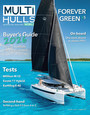
Just as in the automotive sector, electric propulsion is gaining momentum. Five years ago, only a handful of builders offered hybrid solutions; today, as demonstrated in this issue’s Forever Green Buyer’s Guide, nearly half of all sailing multihull manufacturers do so. On the powercat side of the market, the trend toward electric propulsion is equally clear. Most systems still rely on a generator because current battery technology does not yet provide more than a hundred nautical miles of fully electric range. However, thanks to ever-larger solar arrays, it is now possible to remain emission-free at anchor - and in the case of Millikan’s M.10, potentially at all times.
To date, fully electric production multihulls can still be counted on the fingers of one hand: the M.10, the MODX 70 mentioned above and Aventura Yachts’ electric sailing catamarans. Jimmy Cornell’s experiment aboard an electric Outremer 4X ultimately demonstrated just how difficult it is to operate without a range-extending generator. Such a configuration requires both substantial ...
What readers think
Post a comment
No comments to show.