

An Invisible Link Between the Multihull and Its Crew
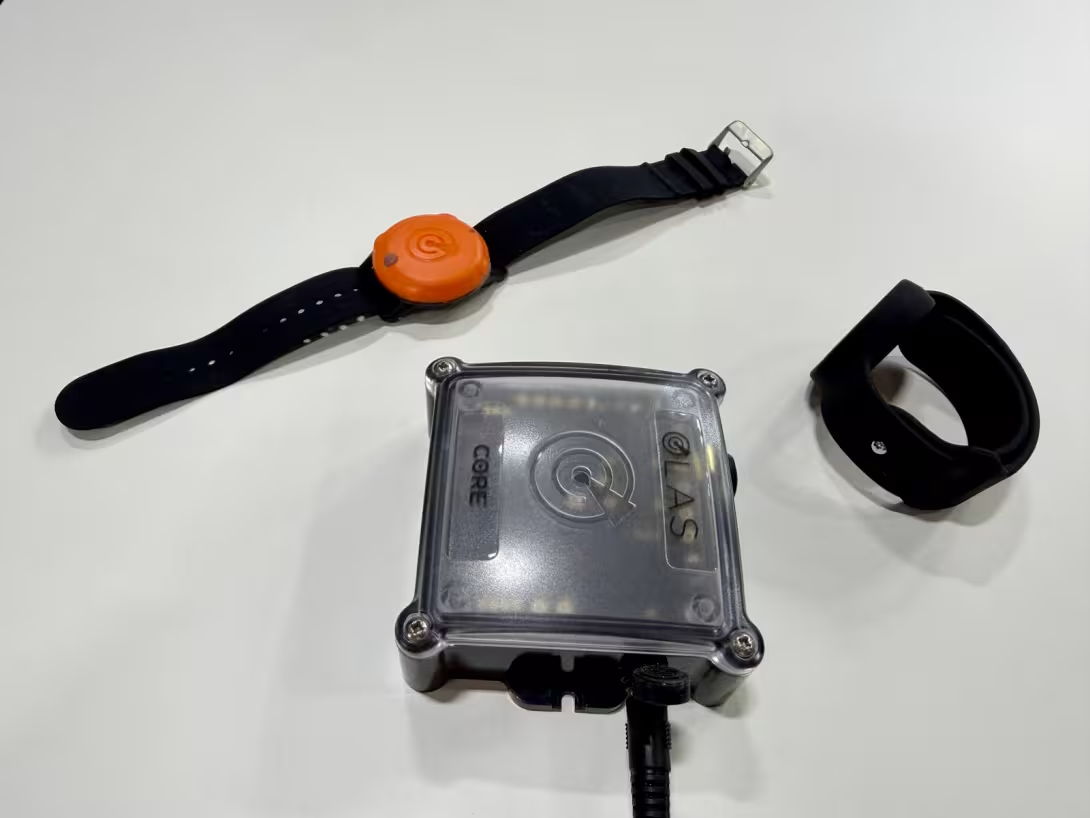
The principle of the OLAS Core (Overboard Location Alert System) is fairly simple: a small unit powered via a USB socket continuously monitors the transmitters worn by the crew. If one of them leaves the reception range or if its transmitter is submerged, the loss of the Bluetooth link triggers an audible alarm backed up by a powerful red light. The OLAS app, available free on iOS and Android, completes the system by recording the smartphone's GPS position at the moment of the alert and providing guidance back to the spot.
For our test, we had two types of transmitter, both worn like a watch: the orange OLAS Tag, powered by a replaceable battery, and the black OLAS T2, which is rechargeable and noticeably more compact.
First Trials at Home
Before taking our equipment on board, we installed the dedicated app on our smartphone and charged the T2 (allow two hours for a full charge). Once the base station was plugged in, we paired the two transmitters. It took a bit of trial and error to activate the T2's monitoring mode, but we soon managed to handle both wristbands simultaneously from the app.
We then ran a series of tests: deliberately switching off each transmitter triggered the alarm, as did putting the T2 on charge while it was still in monitoring mode. That left the question of how our wristbands would behave when submerged. No need to head offshore at this stage: a simple bowl of water allowed us to test both transmitters in turn. With each of the two wristbands, the alarm went off in around two seconds. Pretty convincing!
What If We Really Jumped In?
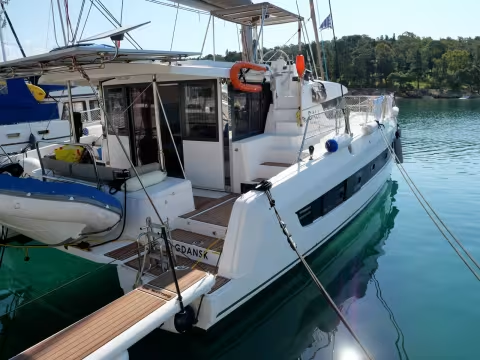
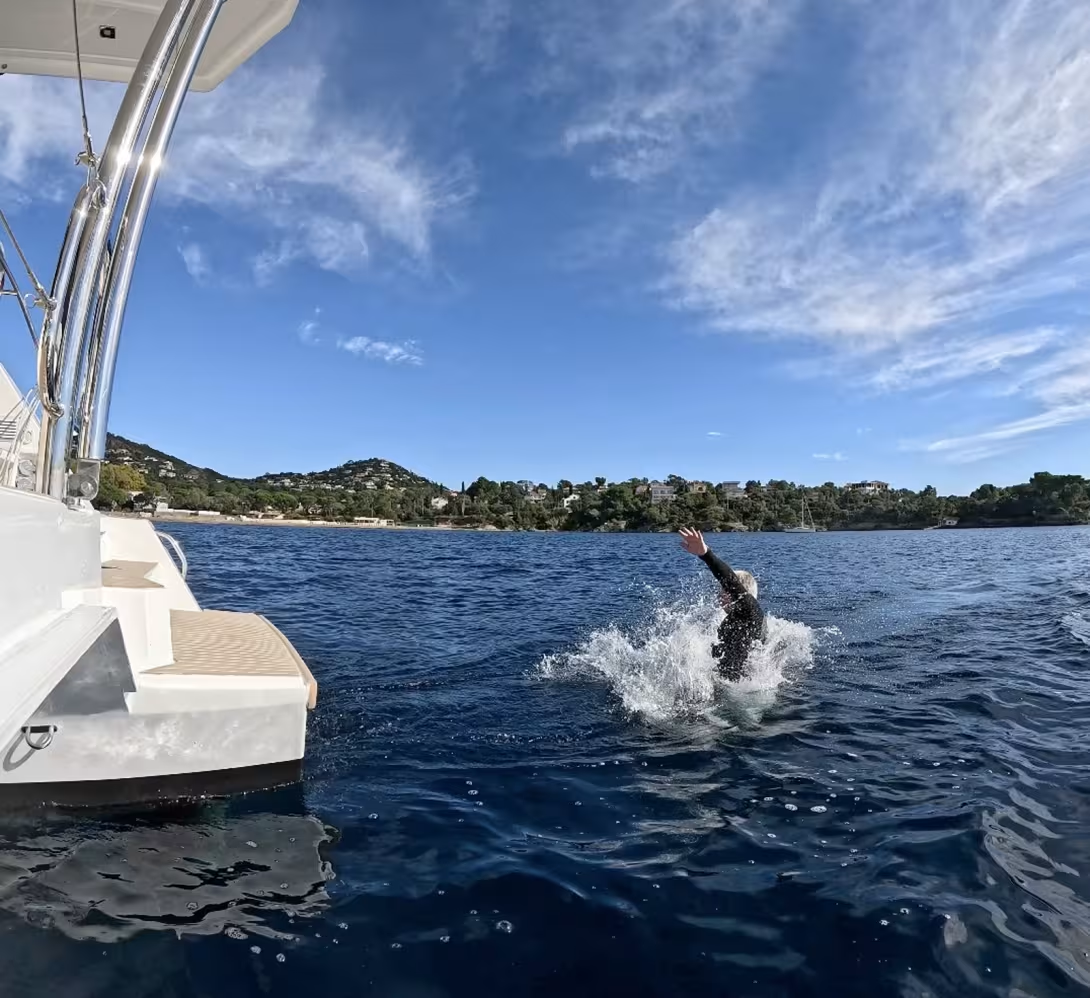
A few days later, during our sea trial of the Leopard 43 in Saint-Raphaël, we took the OLAS Core on board for a more immersive experience, and above all one much closer to real-life conditions… Every precaution was taken for this simulation: crew briefed, catamaran at low speed, close to the beach, and a wetsuit for our tester (the water was 66°F/19°C). Wearing the orange wristband, he deliberately went over the side.
The system's reaction was almost instantaneous: the unit lit up red and sounded its shrill alarm, while the smartphone relayed the alert. The app displayed the recorded position and showed the direction to follow to get back to where the man went overboard. The whole system worked perfectly right up to the recovery of our man overboard and the acknowledgement of the alarm.
One small reservation, however: while the base station's alarm seemed particularly loud in the quiet of our home, it was much less noticeable aboard a catamaran under power. Ambient noise can partly drown out the alarm. Why not offer adjustable volume, with a higher maximum level? In any case, the location of the unit deserves careful thought, even if it depends on having a USB socket nearby.
An Onboard Alert, Not a Distress Call!
It's important to understand what this equipment is designed for: the OLAS Core is intended to alert the people on board and help recover a crew member. The transmitters don't have their own GPS, so the app can't track the drift of the person in the water in real time.
Nor does the system automatically transmit an AIS MOB signal, or a distress message via VHF or to the emergency services. In a real man-overboard situation, it's up to the crew to start the recovery procedure immediately, record the position using the MOB button on the chartplotter and, depending on the situation, alert the emergency services by VHF.
Conclusion
Easy to install, compact and affordable, the OLAS Core won us over during our real-life test. The system is particularly relevant aboard multihulls, whose large deck areas, multiple living spaces and sometimes high speeds don't always allow you to keep every crew member in sight. At night or when sailing shorthanded, being alerted immediately that a crew member has gone missing can obviously make all the difference. A worthwhile complement to traditional personal safety equipment.
Pros
- Installation without touching the boat's electrical system
- Simultaneous monitoring of several crew members
- Fast alert response observed during our tests
- Guidance back to the position of the fall
- Affordable price
Cons
- Alarm partly drowned out by ambient noise when motoring
- T2 monitoring mode setup could be improved
- No real-time individual tracking or automatic distress transmission
Technical Specifications
Manufacturer: ACR Electronics
Model: Exposure OLAS Core
Part Number: EXPOLASCORE
Technology: Bluetooth
Power Supply: 5 V USB
Power Consumption: 13 to 17 mA
Base Station Dimensions: 3.6 × 3.5 × 1.5 in (92 × 90 × 38 mm)
Base Station Weight: 3.9 oz (110 g)
Waterproof Rating: IP67
Alarm Sound Level: 85 dB
Alarm Light Output: 55 lm
Maximum Multihull Length: 50' (15.24 m), 80' (24.38 m) with the OLAS Extender repeater
Maximum Number of Transmitters: 15 to 25 depending on version
App: OLAS, free for iOS and Android
Warranty: 2 years
OLAS Tag Transmitter (Orange)
Dimensions: 1.8 × 1.4 × 0.6 in (46 × 35 × 15 mm)
Weight: 1.1 oz (30 g) with strap
Power Supply: replaceable CR2477 battery
Claimed Battery Life: 3,500 hours
Waterproof Rating: IP67
OLAS T2 Transmitter (Black)
Dimensions: 1.5 × 1.5 × 0.4 in (38 × 38 × 9.5 mm)
Weight: 0.4 oz (12 g)
Power Supply: rechargeable battery
Charging Time: 2 hours
Claimed Battery Life: up to 7 days
Price: US$ 195.95 for the OLAS Core base station alone (ACR list price); OLAS Tag and OLAS T2 transmitters sold separately