Issue #: 205
Published: January / February 2026
- Price per issue - digital : 6.50€Digital magazine
- Price per issue - print : 9.50€Print magazine
- Access to Multihulls World digital archives Digital archives

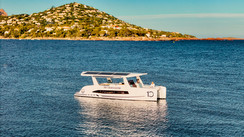
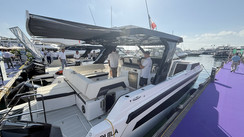
The range and reliability of electric powercats are, quite rightly, key criteria for users - and of course for builders, who are keen to test their new models in real-life conditions. That is how the 100% electric SY62 Open 3-Deck set off from Gibraltar to reach Antigua in four weeks, stopping in Casablanca, the Canary Islands, and Cape Verde.
Under way, the catamaran averaged between 5 and 6 knots, with solar energy as its primary power source.
The SY62 crew also carried out kite-wing traction trials as part of the testing program. The generator was used for 28% of the total navigation time, representing a total fuel consumption of 5,517 liters - around 40% less than that of a conventional powercat. It is also worth noting that the total energy generated by the solar panels over these 25 days and 3,793 nautical miles amounted to 1,227 kWh.
As for the generator, it is reported to have been used for around fifty hours, meaning that only about 150 liters of the 2,700 liters of diesel available were consumed. Considering that a powercat of similar size - such as an Aquila 54, a Leopard 53PC, an Iliad 53F, or a Prestige M7 - burns roughly 10 liters per hour at 6 knots, those 150 liters would represent just 10 hours of running time for these “conventional” diesel-powered models, or about 60 nautical miles… a far cry from the 3,800 nautical miles of the full Atlantic crossing just completed by the 100% electric SY62! Proof that electric propulsion and long-range cruising are indeed compatible.
That said, it is worth remembering that danger often lies close to shore. A powerful cold front that swept through the northern part of the Caribbean arc in early February caused the mooring lines of 100%, which was stationed in the USVI, to fail. The powercat appears to have suffered significant damage.
We will return to this crossing in greater detail in our special issue Forever Green #26.
What readers think
Post a comment
No comments to show.