
We met Karine Rolen, Business Director at Suzuki Marine France, to discover this innovation, which does not involve a new outboard but rather its manufacturing process.
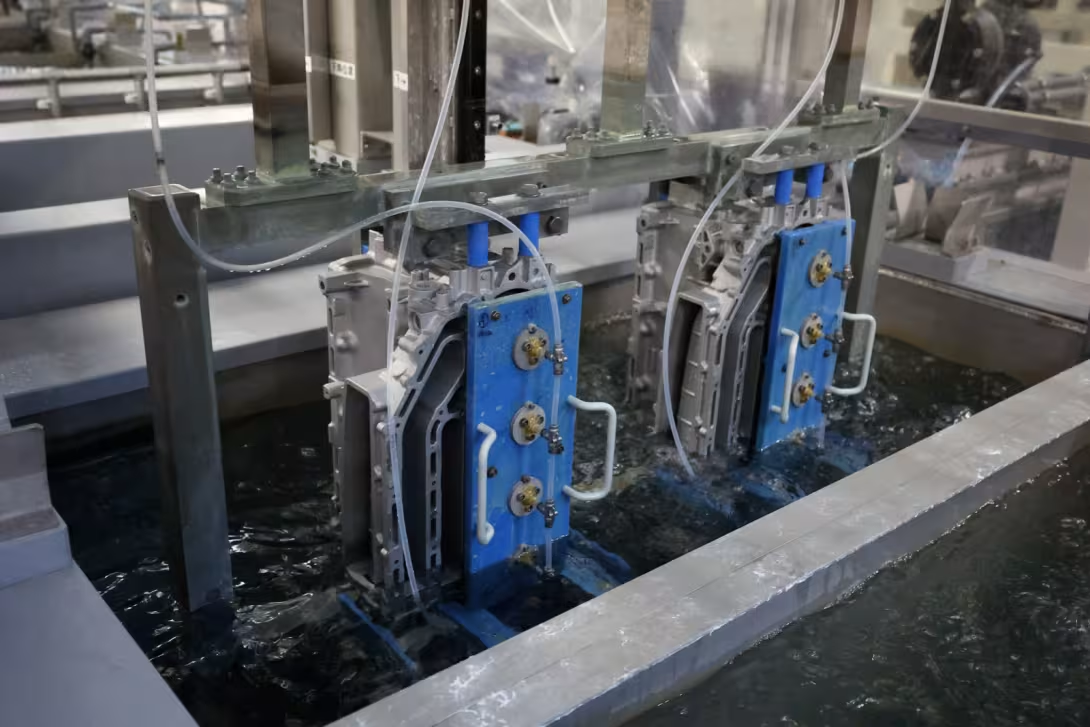
The principle is based on an electrolytic anodizing process that creates a layer of aluminum oxide directly on engine components in contact with cooling water, notably the engine block and cylinder head. A first for mass-produced outboards, the process improves resistance to corrosion as well as to high temperatures of up to 300°C (572°F).
Edge eCoat also reduces the environmental footprint of the manufacturing process. It replaces certain traditional treatments involving paint, thereby eliminating the energy required for drying and curing. Suzuki claims an approximately 50% reduction in CO₂ emissions generated during this stage.
This development forms part of an approach already adopted by Suzuki Marine, which notably chose to make the patent rights for its microplastic collection device freely available so that the technology could be used more widely. “What’s interesting is realizing that innovation isn’t only about new products, but also about existing ones. That’s where the efforts are being made,” says Karine Rolen.
Already available on the DF115B and DF140B, Suzuki Edge eCoat is set to be gradually extended across the entire Suzuki Marine range.